Dwarflabs Dwarf III First Look: Unboxing and Impressions
The landscape of amateur astronomy and wildlife photography has undergone a radical transformation over the last five years. Where enthusiasts once had to lug heavy tripods, complex German equatorial mounts, and expensive DSLR bodies with massive telephoto lenses into the field, a new category of "smart telescopes" has emerged to simplify the process. Among the innovators in this space, Dwarflabs made a significant impact with its previous iterations, particularly the Dwarf II, which offered a portable, dual-lens system that bridged the gap between deep-sky astrophotography and terrestrial observation. With the release of the Dwarf III, the company aims to refine this concept, addressing user feedback regarding sensor quality, build durability, and software integration. This article provides an in-depth first look at the unboxing experience and initial impressions of the Dwarf III, exploring how it stands as a versatile tool for the modern digital explorer.
The Dwarf III arrives as a dedicated "all-in-one" smart telescope. It is designed to be controlled via a smartphone or tablet, removing the need for a traditional eyepiece. By utilizing high-sensitivity sensors and automated tracking algorithms, it allows users to capture the rings of Saturn, distant nebulae, or a nesting hawk from hundreds of yards away with just a few taps on a screen. For those new to the hobby, the Dwarf III represents a low-barrier entry point into complex photography niches, while for veterans, it serves as a highly portable secondary rig that fits into a small backpack.
The Unboxing Experience: First Physical Encounters
Unboxing the Dwarf III reveals a shift toward a more premium and rugged design philosophy compared to its predecessor. The packaging is minimalist yet protective, ensuring the sensitive optics and internal gimbal systems are shielded from transit vibrations. Upon opening the box, the first item encountered is usually the custom-fitted carrying case. This case is a critical component for a device marketed on its portability; it is rigid enough to handle being tossed into a hiking pack but small enough to remain unobtrusive.
Inside the case sits the Dwarf III itself. The primary physical change noticed immediately is the refined chassis. While the Dwarf II had a more utilitarian, plastic-heavy feel, the Dwarf III utilizes updated materials that feel denser and more weather-resistant. The device retains its signature periscope-style design, where the lenses are protected within the body when the device is powered down. This is an essential feature for field use, as it prevents dust and moisture from accumulating on the glass elements when moving between locations. The unit feels balanced in the hand, weighing enough to feel substantial without being a burden during a long trek into a dark-sky site.
Beyond the main unit, the box contains a few essential accessories. These typically include a specialized USB-C charging cable, a small but sturdy tabletop tripod, and perhaps most importantly, a set of magnetic filters or a filter adapter. Dwarflabs has leaned into the feedback regarding light pollution and solar observation, making the integration of filters a more seamless part of the out-of-the-box experience. The inclusion of a dedicated solar filter for the Dwarf III is a major selling point, allowing users to safely photograph sunspots and solar eclipses within minutes of unboxing.
Detailed Product Analysis and Technical Evolution
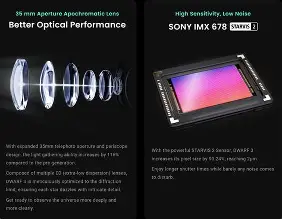
The heart of the Dwarf III lies in its dual-camera system, which has seen significant internal upgrades. One lens is dedicated to a wide-angle field of view, acting much like a finder-scope on a traditional telescope. This lens allows the software to orient itself by plate-solving the stars in the sky or by giving the user a broad view of a landscape to locate a specific bird or animal. The second lens is the telephoto optic, designed for high-magnification captures of celestial objects or distant terrestrial subjects.
A major point of speculation and interest for the Dwarf III is the sensor upgrade. Dwarflabs has transitioned to a newer, more light-efficient sensor that significantly reduces thermal noise during long-exposure astrophotography. In the world of smart telescopes, "noise" is the enemy, appearing as grainy artifacts in dark regions of a photo. By improving the Signal-to-Noise Ratio (SNR), the Dwarf III can produce cleaner images of faint galaxies and nebulae in shorter periods. This is particularly beneficial for users living in suburban areas with moderate light pollution, as the sensor can better distinguish between the faint light of a distant star cluster and the orange glow of city streetlights.
The gimbal system—the motorized mount that moves the lenses—has also been tuned for higher precision. Astrophotography requires the telescope to move at the exact speed of the Earth's rotation to prevent stars from "trailing" or appearing as streaks. The Dwarf III features improved motors that provide smoother tracking, which is also a boon for video recording. When tracking a moving object on land, such as a deer running through a meadow, the updated algorithms allow for more fluid panning, reducing the jerky movements that sometimes plagued earlier smart telescope models.
Find top-rated Cameras & Photography products at great prices.
See Deals →Battery life is another area where the Dwarf III shows evolution. Long nights of imaging deep-space objects can drain a battery quickly, especially when the device is also powering a Wi-Fi or Bluetooth connection to a phone. The Dwarf III features an increased battery capacity and more efficient power management. It also supports "pass-through" charging, meaning users can plug in a standard power bank via USB-C to keep the device running throughout an entire night of observation without interruption.
The Software Ecosystem and User Interface
While the hardware is impressive, a smart telescope is only as good as the app that controls it. The Dwarflabs app has undergone a significant overhaul to coincide with the Dwarf III launch. The interface is now more intuitive, with dedicated modes for "Astro," "Terrestrial," and "Time-Lapse." One of the most sought-after features in this update is the improved "One-Click" astrophotography. Once the device is leveled and pointed at the sky, it can automatically calibrate its position, search its internal database for thousands of celestial objects, and begin tracking and stacking images on its own.
Image stacking is a crucial concept that the Dwarf III handles internally. Instead of taking one long exposure that might be ruined by a passing cloud or a satellite streak, the device takes dozens or hundreds of short-exposure shots. Its internal processor then "stacks" these images, aligning them perfectly and averaging the data to enhance detail and reduce noise. For the end-user, this means watching a faint, fuzzy smudge on the screen slowly transform into a detailed, colorful nebula over the course of ten to fifteen minutes.
Pros and Cons of the Dwarflabs Dwarf III
- Ultra-Portable Design: The compact, lightweight form factor makes it one of the…
Feature Dwarf II Dwarf III ZWO Seestar S50 Aperture 24mm 35mm 50mm Sensor IMX415 IMX678 (Upgraded) IMX462 Weight 1.2 kg 1.35 kg 2.5 kg Lenses Dual (Wide/Tele) Dual (Wide/Tele) Single (Tele) Storage microSD Card Internal eMMC + microSD Internal eMMC Tracking Alt-Azimuth Alt-Azimuth (Enhanced) Alt-Azimuth As the table demonstrates, the Dwarf III strikes a balance between the hyper-portability of the original Dwarf and the higher gathering power of larger units like the Seestar S50. While the Seestar has a larger aperture for deeper space reach, the Dwarf III maintains its lead in versatility by offering the dual-lens system and a much smaller physical footprint, making it the preferred choice for those who value mobility above all else.
Buying Guide: Is the Dwarf III Right for You?
Choosing a camera or telescope in this category depends heavily on your primary use cases. The Dwarf III is a specialized tool that excels in specific scenarios but may not be the "only" camera a photographer needs. Prospective buyers should consider the following factors before committing to the ecosystem.
1. Identifying Your Primary Subjects
If your goal is to capture high-resolution images of the craters on the moon, the phases of Venus, or the rings of Saturn, the Dwarf III is an excellent starting point. However, if you are looking for professional-grade "National Geographic" style wildlife photography, you should manage your expectations. The Dwarf III produces fantastic images for social media and personal prints, but it cannot match the sharpness of a $10,000 prime lens on a full-frame Sony or Canon body. It is designed for those who want to see things they otherwise couldn't, without the massive financial and physical overhead of professional gear.
Find top-rated Cameras & Photography products at great prices.
Shop Amazon →2. Portability Requirements
This is where the Dwarf III wins. If you are a hiker, a van-lifer, or someone who frequently travels by air, the Dwarf III is likely the best option on the market. Most telescopes require dedicated cases that take up half a car trunk. The Dwarf III fits in the same space as a large pair of binoculars. If you find yourself avoiding the hobby because your current gear is too heavy to set up, the Dwarf III is the remedy for that friction.
3. The Learning Curve
Traditional astrophotography has a steep learning curve that involves polar alignment, guide scopes, and complex post-processing software like PixInsight. The Dwarf III bypasses almost all of this. It is perfect for children, students, and busy adults who want the results of astronomy without the frustration of troubleshooting hardware in the dark. That said, it still offers advanced modes for those who want to manually control ISO, exposure time, and white balance, allowing you to grow into the hobby.
4. Environmental Considerations
Consider where you will be using the device most often. If you live in a very humid environment, the improved sealing on the Dwarf III is a major advantage over the Dwarf II. Similarly, if you plan to use it for birding by the ocean, the enclosed lens design protects the optics from salt spray more effectively than a traditional open-tube telescope might.
Real-World Use Cases
To truly understand the value of the Dwarf III, one must look at how it performs in the field. For a birdwatcher, the device can be set up on a fence post or a picnic table. Using the wide-angle lens, the user can scan a tree line. Once a specific bird is spotted, a simple tap on the phone screen tells the telephoto lens to lock onto that subject. The "AI Tracking" feature then keeps the bird in frame even as it hops between branches. This allows the observer to watch the bird's natural behavior on their tablet from twenty feet away, ensuring they don't spook the animal.
For the amateur astronomer, a typical night with the Dwarf III involves placing the unit on a flat surface and opening the app. After a brief initialization, the user might select the "Orion Nebula" from the menu. The Dwarf III slews to the target, confirms its location using the stars, and begins its stacking process. While the telescope works, the user can sit in their car or inside their house (within Wi-Fi range), watching the image build in real-time. This "social" aspect of the Dwarf III—where multiple people can connect to the same stream to see what the telescope is seeing—makes it a perfect tool for star parties or educational demonstrations.
Conclusion
The Dwarflabs Dwarf III is more than just a minor spec bump; it is a mature realization of what a compact smart telescope should be. By addressing the physical durability and sensor limitations of the previous generation, Dwarflabs has created a device that is as capable as it is convenient. It occupies a unique niche in the camera world, serving as a telescope, a telephoto camera, and a surveillance tool for nature lovers all at once. While it may not replace the massive apertures of dedicated observatories or the high-speed bursts of professional sports cameras, it provides a level of accessibility to the wonders of the natural and celestial world that was previously unthinkable. For the curious explorer who wants to carry the universe in their pocket, the Dwarf III is a compelling and powerful companion.